

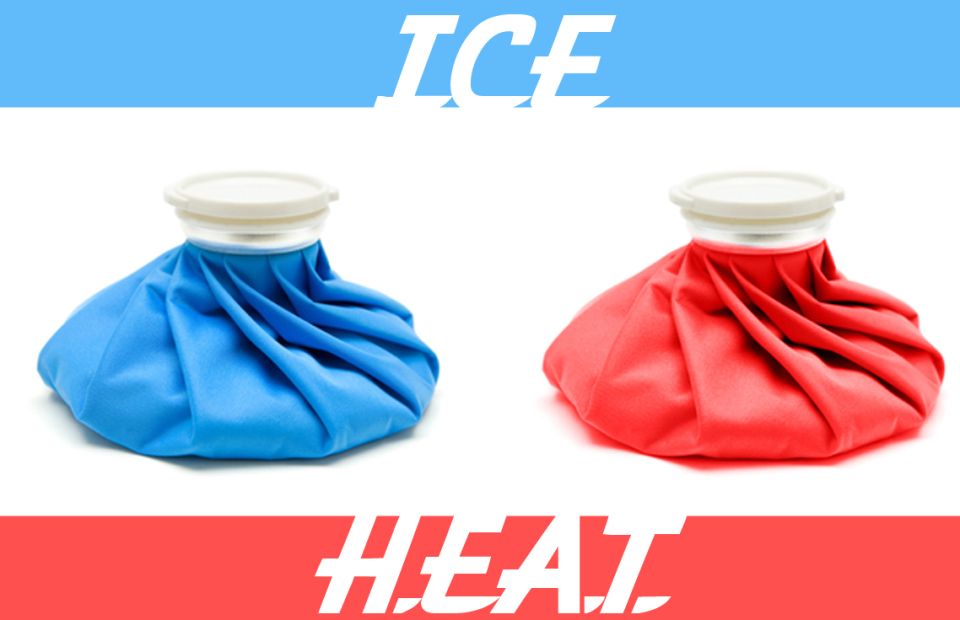
19 11 月 Heat vs Ice: Which one do I use for my injury?
You may have heard the biggest debate of all time which is: What’s better, heat or ice? This debate has been going on since the 80/90’s and till this day everyone has a different opinion on this.
Some people may suggest to use heat for 5 minutes or to use ice for 2 minutes or even to use a combination of both. It can all be confusing but, in this blog we’ll talk about the pros and cons of both and whether it makes a difference.
Introduction:
Let’s take a step back in time and talk about how it started. The debate initially started when physician Dr. Gabe Mirkin coined the acronym we all know as R.I.C.E (Rest, Ice, Compression & Elevation) in 1978. This made ice the go-to treatment for all sprains, strains and if there were any signs of swelling/inflammation.
Fast forward to the 2000s, the advancement of medical research questioned whether ice actually helped or not. Studies showed that inflammation isn’t as bad as we thought and could even play an important role with healing especially with soft tissue (muscle, tendons, etc)
Inflammation is generally misunderstood and is believed to be interchanged with the term swelling however, both inflammation and swelling are entirely separate. Let me explain, inflammation is a defensive mechanism that our body naturally does and is the first stage of a three-phase sequence of tissue repair. On the other hand, swelling is the accumulation of waste at the end of the inflammatory phase which hasn’t been flushed out. Therefore, it’s pretty important to have inflammation especially when injuries are fresh.
So is there a difference or when to use heat or ice?
From what we know at this point of time here are some of the pros and cons of using heat and ice.
Heat:
| Pros for heat | Cons for heat |
| Relaxes Tight Muscles and Joints: Great way to promote localised blood flow, muscle relaxation and reduce pain. | Not for Acute Injuries Applying heat too soon (e.g., after a fresh sprain or bruise) can increase bleeding and swelling. This can lead to more sensitivity of the tissues and potentially make it feel more sore. |
| Reduces Pain and Tension: Reduces muscle spasms and helps areas of chronic discomfort (e.g., neck pain, lower back pain) | Can Worsen Inflammation In the inflammatory phase (first 48–72 hours), heat may aggravate symptoms. |
| Great for Chronic Conditions Particularly effective for osteoarthritis, old injuries, chronic back or neck pain, and stress-related tension | Risk of Burns Using heat for too long or when too hot may result in burns on the skin therefore, we must be cautious when using this. |
| Promotes Mobility Warming up joints or muscles before activity may improve movement and may reduce injury risk. | Temporary Relief Only It doesn’t address the root cause and is only temporary. With that being said, it is okay to use it just to get by until you see a practitioner for further help. |
| May Increase Pain in Some Conditions Not all individuals may benefit from heat as those with nerve issues may have altered sensations which may lead to worsening of symptoms. Therefore, if unsure, check with your practitioner before doing so! |
Ice
| Pros for ice | Cons for Ice |
| Reduces Pain and Nerve Activity Ice numbs the area by slowing nerve conduction, providing fast, short-term pain relief. | May Delay Healing if Overused Greater research demonstrating that prolonged/excessive use of ice can slow down the natural course of inflammation which is essential for recovery |
| Controls Bleeding in Acute Trauma Useful immediately after injury to minimize internal bleeding from micro-tears in soft tissue. | Can Mask Pain (Too Much) Temporary relief might lead patients to resume activity too soon, risking re-injury. |
| Decreases Muscle Spasm The cold can potentially reduce spasms or muscle guarding in the acute stage. | Risk of Cold Burns or Nerve Damage Similar to the heat, leaving it on for long periods of time may result in cold burns and those with nerve type injuries may not have the best sensation therefore, increasing the chance of cold burns. |
| Convenient and Accessible Ice packs, cold compresses, or frozen peas – it’s easy for anyone to apply. | Doesn’t Address Underlying Dysfunction It doesn’t address the root cause and is only temporary. With that being said, it is okay to use every now and then until you see a practitioner for further help. |
Quick comparison:
| Condition | ICE ❄️ | HEAT 🔥 |
| Swelling or inflammation | ✅ | ❌ |
| Muscle tightness or spasm | ❌ | ✅ |
| Chronic low back/neck pain | ❌ | ✅ |
| Warming up before activity | ❌ | ✅ |
| After exercise (DOMS) | ✅ | ✅ |
| Stiff joints or arthritis | ❌ | ✅ |
| Fixing the problem | ❌ | ❌ |
P.E.A.C.E & L.O.V.E
More recently, more practitioners have moved on from the R.I.C.E method and moved on to PEACE & LOVE which stands for:
P: Protect – Reduce putting weight through it but still continue to move within your limits.
E: Elevate – Elevate the injured area above the level of the heart.
A: Avoid anti-inflammatories – These medications may delay healing especially in the early stages.
C: Compress – Using compression bandages may help with the fluid build up however, it should not restrict movement or blood flow.
E: Educate – Be given the appropriate instructions for how to manage the issue.
L: Load – If able to, put some weight through the injured area as soon as possible if your body allows it and if the pain is manageable.
O: Optimism – It’s not always the end of the world. Most likely it will get better with time so keep your head up.
V: Vascularisation – Get that blood flow working, moving the area as soon as possible is the way to go (within limits of course).
E: Exercise – At the end of the day we want to make sure you get back to where you were before you got injured so getting that movement and strength back is key!
Bottom line:
Both ice and heat have their place in recovery. The key is using the right one at the right time and not relying solely on passive therapies.
If you’re ever unsure which one is best for you, ask us during your appointment at Sun Chiropractic or contact our clinic for advice tailored to your body and your goals.
References:
(Thermal Therapy: An Overview; F. D. Denehy, S. W. Murphy (2017)
(The Effect of Heat Application on Muscle Pain and Spasm; Marcuzzi, N. C., & Salinas, C. (2015)).
( The Effects of Heat Application on Soft Tissue Flexibility; R. L. Hubbard, A. W. Kocsis (2009).
(Motor and Sensory Nerve Conduction Are Affected Differently by Ice Pack, Ice Massage, and Cold Water Immersion Physical Therapy Journal (2010) — Herrera et al).
(The Effect of Cryotherapy on Healing: A Systematic Review and Meta-Analysis J. L. K. Smith, C. B. Moore, et al. 2024).
(The R.I.C.E Protocol is a MYTH: A Review and Recommendations 2020).