


18 Oct Golfer’s Elbow – Why Your Elbow Hurts and What You Can Do About It
If you’ve noticed a nagging pain on the inside of your elbow, especially when gripping, lifting or using your hands, you may be dealing with Golfer’s Elbow. Despite the name, you don’t need to play golf to get it. We commonly see it in office workers, gym-goers and manual workers at Sun Chiropractic (Reece et al. (2024) Stat Pearls).
Let’s break it down in a simple, easy-to-read way.
What exactly is Golfer’s Elbow?
Golfer’s elbow (medically known as Medial Epicondylalgia) happens when the tendons on the inside of the elbow become overloaded and irritated. These tendons connect your forearm muscles to the elbow and are used every time you grip, lift or twist your wrist.
Too much load with minimal recovery can lead to pain and weakness.
Why does it happen?
Golfer’s elbow usually develops slowly. Common triggers include:
– Repetitive gripping (gym, tools, racquets).
– Long hours at a desk using a mouse or keyboard.
– Sudden increase or change in lifestyle (e.g. going from gymming once a week to 5 times a week).
– Poor exercise or sport technique.
– Weak forearm or shoulder muscles.
In simple terms, the tendon can become irritated when the load placed on it exceeds what it is currently able to handle (DeLuca et al., 2023) Journal of Orthopaedic Reports).
What does it feel like?
People often describe:
– Pain or tenderness on the inside of the elbow
– Pain with gripping, lifting, twisting, or wrist flexion
– Reduced hand or forearm strength
– Stiffness after activity or in the morning
– Symptoms that may travel down the forearm
If you also notice numbness or tingling in your fingers, it is worth getting assessed, as this may suggest irritation of the ulnar nerve rather than just tendon overload (NHS 2025).
Should you stop everything?
Not necessarily.
Short-term reduction of aggravating activities can help settle symptoms, but complete rest is usually not the answer. Tendons tend to respond better to the right amount of gradual loading rather than prolonged avoidance of movement. The goal is to reduce aggravation while rebuilding strength and load tolerance over time (Reece et al. (2024) Stat Pearls).
How can Physiotherapy and Chiropractic care help?
At Sun Chiropractic, treatment focuses on:
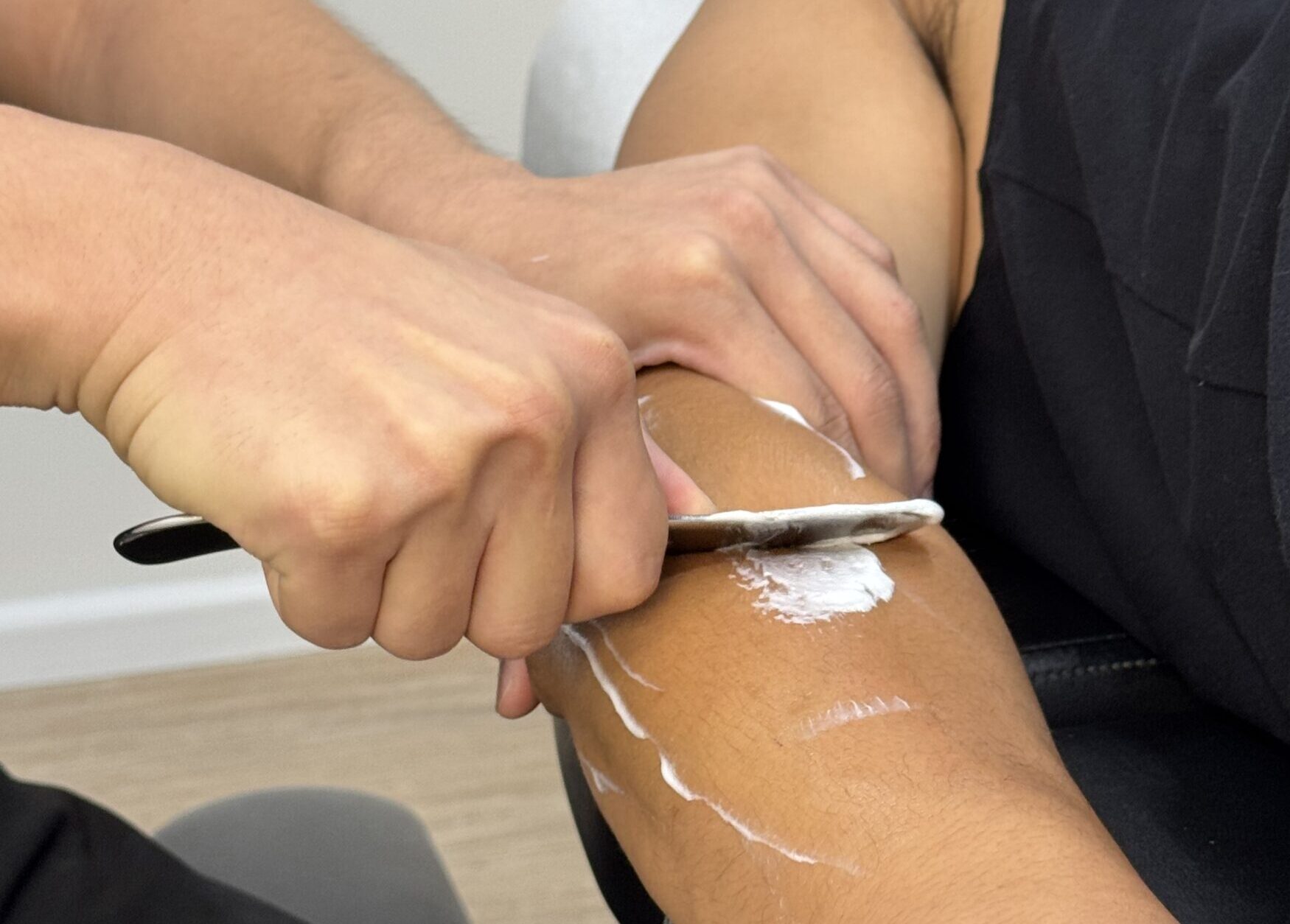
– Reducing pain and muscle tension via Massage, Dry needling, Shockwave, etc.
– Improving movement around the elbow, wrist and shoulder.
– Strengthening the tendons safely.
– Improving strength in the forearm and upper limb
– Addressing training, work, or technique factors
– Helping you return to activity gradually without repeated flare-ups
Hands-on treatment and other pain-relief strategies may sometimes be used to help manage symptoms, but exercise and load management are usually the key parts of recovery (Reece et al. (2024) Stat Pearls).
How long does recovery take?
Recovery varies from person to person.
Some people begin improving within several weeks, while others take months, especially if symptoms have been present for a long time or the tendon keeps getting irritated. In general, earlier management and consistent rehab tend to lead to a smoother recovery (MyHealth Devon NHS, 2026).
When should you get it checked?
It’s a good idea to seek help if:
– Pain lasts longer than 2–3 weeks.
– Grip strength is getting weaker.
– Pain keeps returning.
– It’s affecting your work, sport or daily life.
In summary
Golfer’s elbow is a common and treatable condition. With the right balance of hands-on care, exercise and guidance, most people recover well.
If elbow pain is holding you back, the team at Sun Chiropractic is here to help you get back to moving comfortably and confidently.
References:
Reece, C. L., & colleagues. (2024). Medial epicondylitis. In StatPearls. StatPearls Publishing.
DeLuca, M. K., Cage, E., Stokey, P. J., & Ebraheim, N. A. (2023). Medial epicondylitis: Current diagnosis and treatment options. Journal of Orthopaedic Reports.
https://myhealth-devon.nhs.uk/my-condition/condition/golfers-tennis-elbow/